
The Visibility Oracle Wasn't Built to Provide
Every tool in the vendor management stack owns one stage of the lifecycle. The supplier record keeps living for years after that, and in most Oracle environments, nobody is watching it.

A new supplier record in Oracle Fusion is usually at its best on the day it is created. The W-9 or W-8 is on file. The banking details were confirmed. The contact is someone who still works there.
Then the relationship runs for three, five or ten years. Contacts leave. Sites go quiet. A W-8 reaches its end date. An acquisition brings a second record for the same legal entity. Purchase orders stay open after the work is done.
None of that happens at onboarding, which is where most vendor management effort and software is concentrated. It happens afterward, in the long stretch of the lifecycle that very little is built to govern.
The lifecycle everyone agrees on
The industry largely agrees there are six key stages in vendor management, and that AP owns four of them:
Offboarding is widely regarded as the stage most organisations skip, and duplicate vendor records are often traced back to that gap. We agree with the diagnosis.
Look at the list closely and a pattern appears. The first four stages are events. They happen once, on a date, with a clear owner. The last two are conditions. They last for the entire life of the relationship, and they are where most supplier data problems accumulate.
Where the tools stop
Most of what is sold as vendor management software covers one slice of that lifecycle. Each slice does its job well. None of them is built to watch the supplier record itself once it exists.
| Lifecycle stage | Typical tool | What it does not do |
|---|---|---|
| 01 Identification and selection | Sourcing and source-to-pay suites | Maintain the record after award |
| 02 Due diligence and onboarding | Supplier portals and onboarding workflows | Revisit the record after intake |
| 03 Contracting | Contract lifecycle management | Track the supplier data behind the contract |
| 04 Vendor master data setup | Oracle Fusion, the system of record | Monitor the record for drift after it is saved |
| 05 Ongoing performance and payment | Invoice automation and payment platforms | Govern the supplier data the payment relies on |
| 06 Offboarding | Usually a manual review, when it happens | Surface what should be closed |
The payment layer is the clearest example. Your payment platform can move money to the right account. It cannot tell you the supplier record behind it went stale in March.
That is not a flaw in the payment platform. It is a different job. Moving money and governing the record the money depends on are two separate responsibilities, and most organisations have only bought software for the first one.

Even clean Oracle data does not stay clean
A supplier record does not fail all at once. It drifts, one field and one event at a time:
- Contacts leave. The email on file belongs to someone who moved on, or to an internal employee who stood in during setup.
- Sites go quiet. A supplier site that has not been invoiced in 12 months stays open and selectable.
- Tax forms lapse. A W-9 has no official expiry but drifts out of date when nobody updates it. A W-8 generally remains valid through the last day of the third succeeding calendar year unless circumstances change.
- Duplicates form after creation. Acquisitions, re-adds after an inactivation and separate business units setting up the same vendor all create second records long after onboarding checks have run.
- Purchase orders outlive the work. Orders stay open, owners leave the company and committed spend quietly stops matching reality.
The cost of that drift is well documented. APQC benchmarking reports that top performers still see 0.8% of annual disbursements as duplicate or erroneous, while bottom performers report 2%.
None of these problems start at onboarding. They start in the years after it.
Oracle Fusion was built to store data, not govern it
Oracle Fusion is the right system of record for supplier data. It holds the record faithfully, enforces the fields it is configured to enforce and runs the transactions that depend on it.
What it does not provide natively is supplier record drift monitoring. Oracle stores the W-8, but it does not tell AP the form lapses this December. It stores the supplier site, but it does not raise that the site has been dormant for 14 months.
There is also an ownership gap. In most Fusion environments, procurement creates the supplier record and AP inherits the consequences. When a record goes stale, it is often unclear whose job it is to notice.
That combination, a record that keeps changing and an organisation where no one clearly owns watching it, is why vendor master problems keep coming back after every cleanup.
Governing the record for the rest of its life
Mi Optii is built for stages five and six, the part of the lifecycle that lasts longest and gets the least attention. It is a continuous monitoring layer for Oracle Fusion AP that surfaces supplier-data issues, process inefficiencies and compliance risks before they hit your payment run.
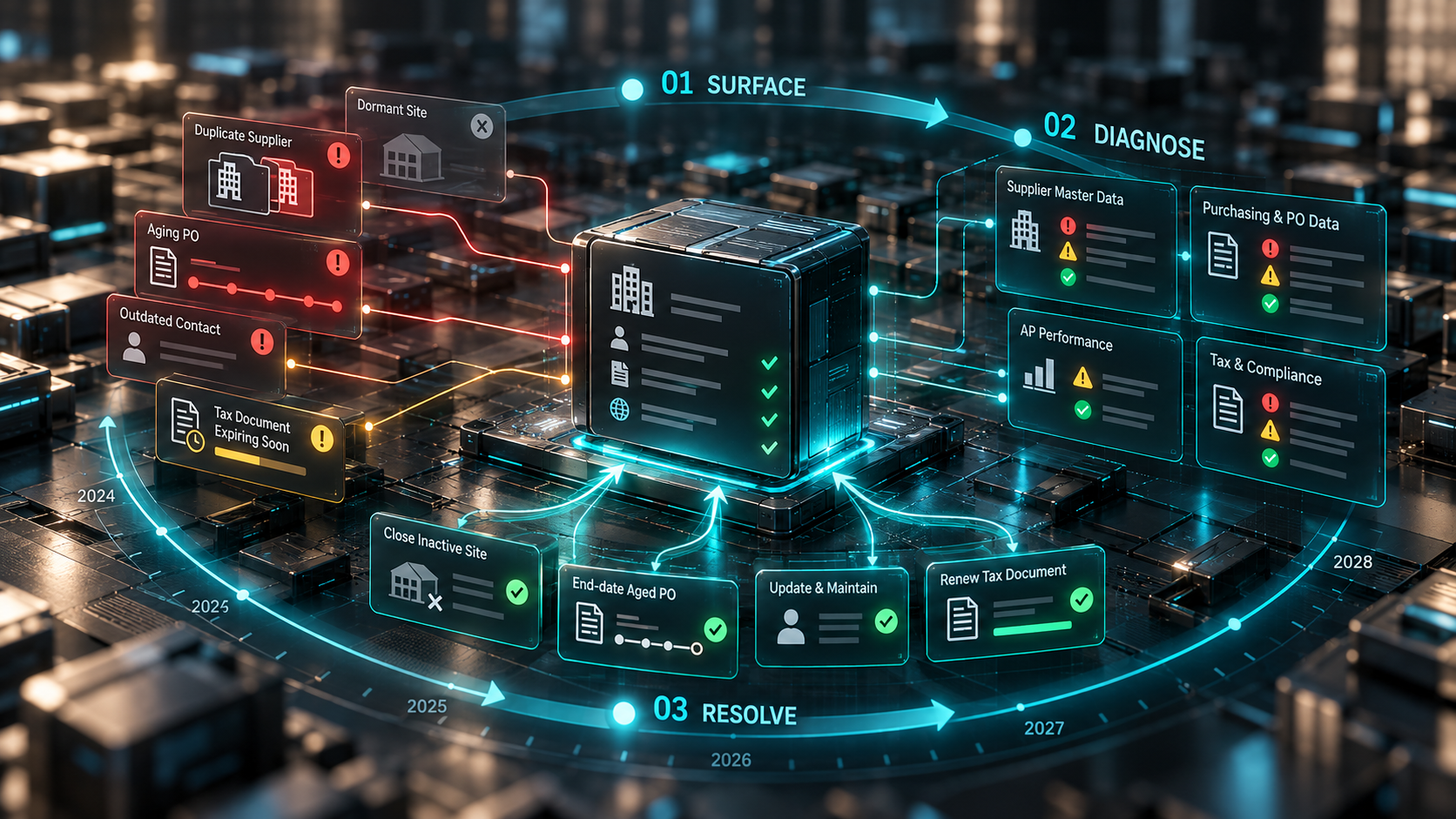
Surface
Mi Optii connects to Oracle Fusion through approved Oracle APIs, with no middleware, and scans supplier, purchasing and invoice records on a daily sync.
Diagnose
Findings are flagged on a Red, Amber, Green scale and organised into four pillars:
Resolve
Mi Optii does not stop at the finding. Teams can close or inactivate aged suppliers and close or end-date aged purchase orders directly in Oracle, individually or in bulk, without a new approval workflow. Inactivated suppliers can be reactivated later. Incomplete records are flagged for your team to correct in Oracle rather than changed automatically.
That is what governing stage six looks like in practice: the offboarding step that usually gets skipped becomes a routine action on a list Mi Optii has already prepared.
A complement to the stack, not another vendor master
Mi Optii does not replace your sourcing suite, onboarding portal, contract system, invoice automation or payment platform. It does not keep its own supplier list either. Oracle remains the system of record, and Mi Optii reads from it and acts on it directly.
That matters because every tool that maintains a separate vendor list creates a second source of truth and a sync problem to manage. Governing the record where it already lives removes that problem instead of adding to it.
The result is a clear division of labour. The tools you have keep doing what they were bought to do in stages one through five. Mi Optii watches the record underneath all of them and keeps stage six from being skipped.
For how this works as a day-to-day operating model, read From Cleanup Projects to Continuous Control.
The question worth asking
Pick a supplier your organisation onboarded three years ago. Is the contact still there? Has the site been invoiced this year? If it is a foreign supplier, when does its W-8 expire?
Oracle supplier data governance and Mi Optii
What is supplier data drift?
Supplier data drift is the gradual decline in the accuracy or usefulness of supplier records as contacts leave, sites become inactive, tax documentation ages, duplicate records appear and purchase orders remain open after work is complete.
How does Mi Optii support Oracle supplier data governance?
Mi Optii connects to Oracle Fusion through approved Oracle APIs, surfaces supplier, purchasing, AP and tax issues, groups findings by operational pillar and supports authorised teams in resolving applicable records directly in Oracle.
Can Mi Optii support Oracle migration projects?
Mi Optii can help teams review supplier, purchasing, tax and AP conditions around Oracle change programmes by making data quality and operational issues easier to see and prioritise.
Does Oracle Fusion automatically monitor supplier record changes?
Oracle Fusion is the system of record for supplier data. Mi Optii adds continuous operational monitoring for record drift, ageing documents, inactive records and other supplier-data conditions.
See what has happened to your supplier records since onboarding.
Connect a test environment, review your Oracle Fusion supplier data with Mi Optii, then connect production.